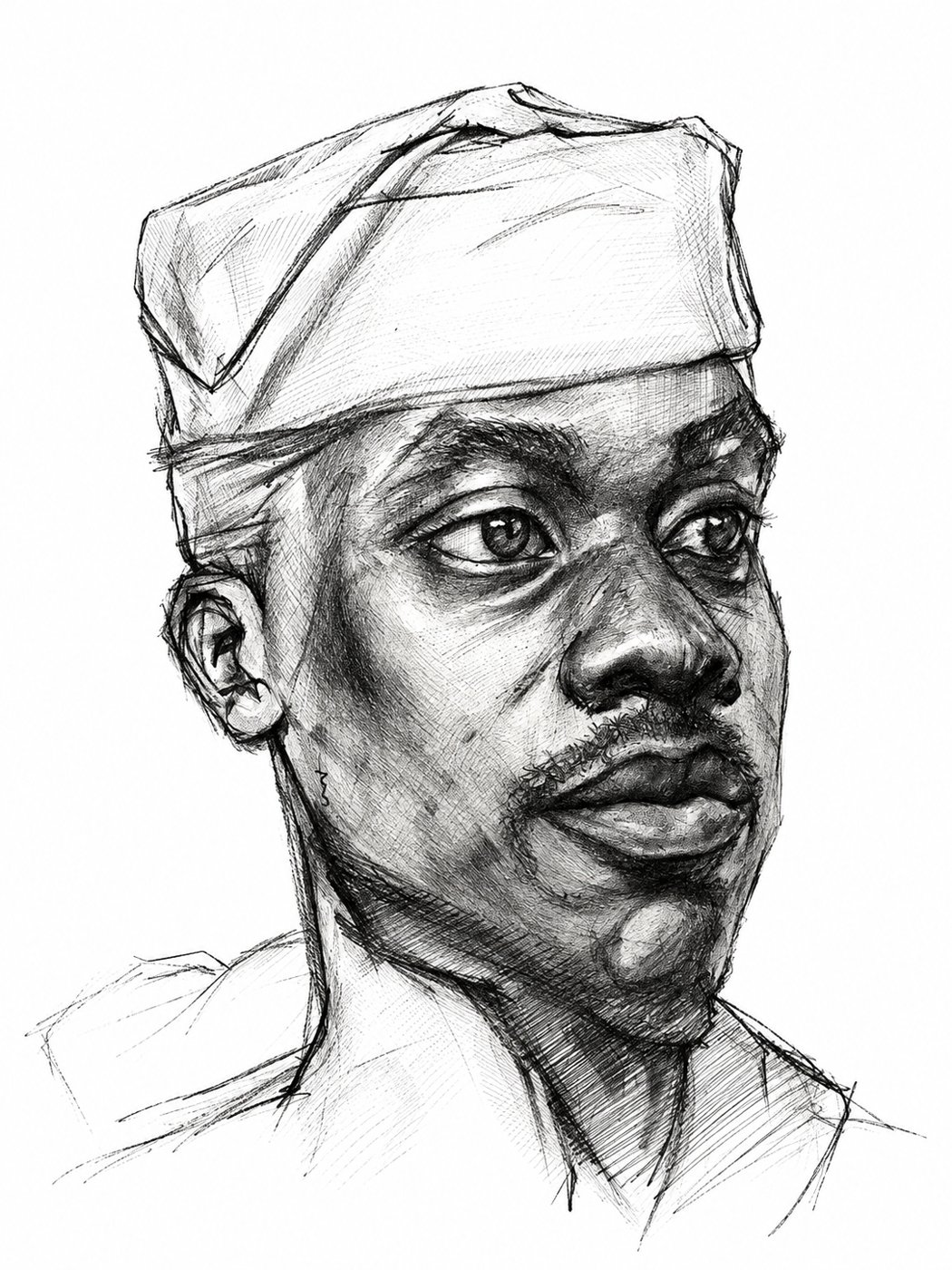
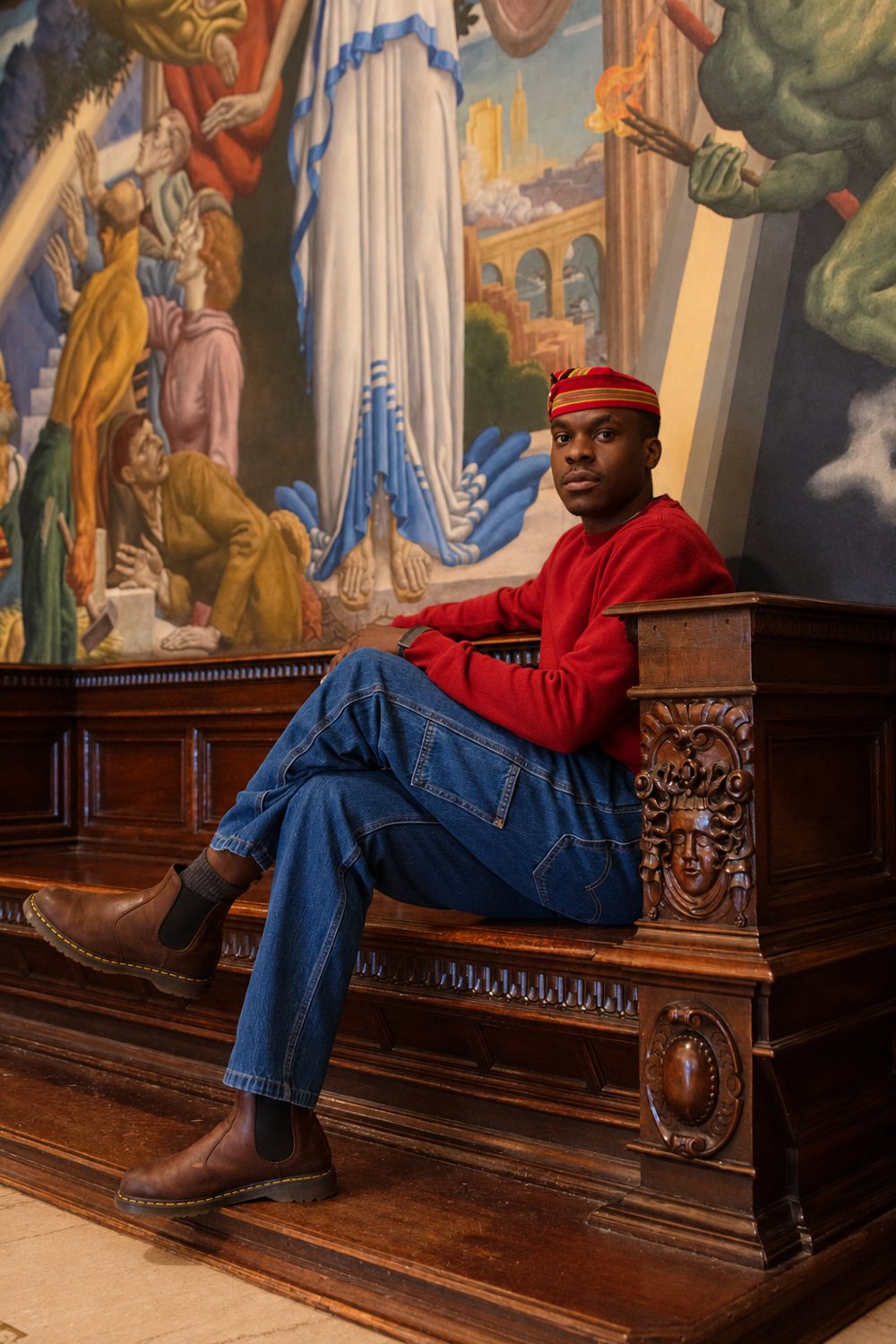
The painting begins with a warm ochre ground, across which angular lines trace the columns and vaults of a grand interior. The space builds outward, layer by layer, moving between warm yellows and cool blues, exposed drawing and passages of fuller color. Light carries the eye toward the artist at the center, whose silhouette shifts across the painting’s vertical divide.
The artist’s presence brings the room’s monumental scale into contact with the intimate work of the studio. Easels, canvases, and the poised brush place the act of painting within a space already shaped by generations of labor.
Works
Paintings
Portraits & studies
Sculpture
Digital
[Courtside]
Digital drawing on iPad
01Gesture02Line03Colour
Commissions
2022The Extent of My SoulPortrait of Abuela Claudia for In the Heights, acrylic on canvas, 6 × 4 ft. GS Lounge, Columbia University, New York
2019Julius NyererePortrait for Peking University, Beijing
2018Nelson Mandela CentenaryPortrait for the Embassy of South Africa, Beijing
2017Relief for DominicaBeijing
2023–25Family portraitsDrawn for women at Rikers Island to send to their children, through Columbia's Justice-in-Education program
OngoingPrivate commissionsPortraits and paintings for private homes and collectors
12 Brass Street residency
A residency with 12 Brass Street, an Atlanta-linked consultancy that brings African art to global markets, ending in a solo exhibition in 2023. In the studio, the Baldwin portrait took shape on the easel, surrounded by pencil studies of his face and of figures and architecture.
In the studio at the 12 Brass Street residency
With the Baldwin portrait
Exhibitions
Solo
202312 Brass StreetAtlanta · residency and solo exhibition
2022Out of the BoxFlorence, Italy
Awards & talks
2026Elizabeth D. Rudolf ScholarColumbia University · also 2024, 2025
2025Columbia GS Service Award
2024Columbia Undergraduate Research SymposiumPresenter · Krieg and the Morgan Library mosaics
2018Pride of Africa – Asia Pacific AwardsBeijing
Group
2025LeRoy Neiman GalleryColumbia University, New York
2024James Baldwin Centennial: Inspired by BaldwinEaston Arts Council · Easton Public Library, Connecticut
2021–26GS Arts & Research CollectiveColumbia University, New York · Jean Charles (2021–22), sketch of a woman (2022–23), The Extent of My Soul (2023–24), Studio Akkim 514 (2025–26)
Art, money & the numbers · Independent research, 2026
Can art beat the S&P 500?
What one Rothko really tells us
A spectacular resale can tell us what happened to one painting. It takes much more to establish what an art buyer should expect to earn.
$6.73mChristie's, 14 May 2003
$85.8mSotheby's, 14 May 2026
11.7%a year, on reported prices
A friend challenged me to answer a deceptively simple question: is art a good investment? If he put his money into a painting, could it earn more than the stock market?
His example was a blue-chip Rothko, and that sent me straight into the numbers. It’s where so many of these arguments start. Someone picks an extraordinary painting, finds two impressive auction prices, and sets a chart next to the S&P 500. Before long, one painting’s run has turned into a claim about “the art market.”
That leap is what I wanted to test. I’m not against people who collect with an eye on returns; there’s room for all kinds of collectors. What bothers me is art treated as something to flip as fast as possible, and rare successes sold as if they were an ordinary investment.
The Rothko in my study is a useful test precisely because it did so well. Its reported auction prices imply roughly 11.7% annualized growth over 23 years. That is a remarkable result. It still does not establish that buying art generally beats the S&P 500.
Start with the painting, not the headline
The work is Mark Rothko's Brown and Blacks in Reds, painted in 1957. Its history includes Sidney Janis Gallery and the Seagram Collection; Christie's catalogue records exhibitions at the Whitney, the Guggenheim and Tate, and its inclusion in David Anfam's catalogue raisonné. Those details explain why this is a serious example of a blue-chip work, not an interchangeable purchase in a broad category called art.1,2
The study has two transaction anchors: $6,727,500 at Christie's on 14 May 2003 and approximately $85.8 million at Sotheby's on 14 May 2026, both including buyer's fees. Sotheby's confirms the rounded 2026 result, and contemporary reporting records the 2003 purchase amount.1,3,4 Using the rounded exit price, the arithmetic is straightforward:
Price multiple 85,800,000 ÷ 6,727,500 ≈ 12.75×
CAGR (85,800,000 ÷ 6,727,500)1/23 − 1 ≈ 11.70%
CAGR means compound annual growth rate: the constant yearly rate that would connect the starting and ending amounts. It does not mean the painting rose 11.7% in every intervening year. There are two sale observations here, not a continuous record of prices at which its owner could have sold.
How a graph turns one Rothko into “the art market”
The chart below puts the Rothko beside the S&P 500 using the figures in my research. Both start at 1×. The red curve connects the painting's two reported auction prices by constant compounding; the blue curve applies the study's reported 9.3% price-only S&P growth rate over an illustrative 23 years. The endpoints come out at about 12.75× and 7.73×.1
One Rothko beside the S&P 500
Same starting value, using the study's reported growth rates
0×2×4×6×8×10×12×14×
0510152023
Years since entry (illustrative 23-year horizon)
Rothko12.75×11.7% auction-price CAGR
S&P price only7.73×9.3% rate from the study
Illustrative curves, not observed annual prices. Only the Rothko's endpoints are sale observations. The S&P line excludes dividends. The chart compares one painting with an index; it cannot establish an art-market return.
The Rothko curve is (85.8 ÷ 6.7275)t/23; the S&P curve is 1.093t, a model using the study's reported price-only rate, not a historical index series. The S&P figure is not verified over the painting's exact dates: the source uses an August 2026 market endpoint and a May 2026 sale. Neither curve measures the owner's return after all costs. Source: research, pp. 6–9.
This is the visual foundation of the argument I wanted to challenge. The red curve finishes higher, so it is tempting to announce that “art outperformed stocks.” But the chart contains one selected Rothko and one equity benchmark. Relabelling that red curve “the art market” is the unsupported step. The graph has no observations for other works, no representative portfolio of art, and no evidence that a buyer could have picked this winner in advance.
The smooth curves can also suggest more evidence than we have. The Rothko was not priced every year along that red line, and the blue line does not reproduce the stock market's actual rises and falls. They show the arithmetic of compounding the study's figures. They cannot reveal the painting's intervening risk or establish a date-matched investment result.
Leaving out dividends makes the apparent advantage larger still. My research compared the painting's 11.7% with a 9.3% annualized increase in the S&P 500 price index: an apparent lead of 2.4 percentage points a year. But a price index excludes dividends. A total-return index includes their reinvestment, which makes it the right starting point for comparing the growth of an equity investment.1,5
The study estimates an S&P 500 total return of about 11% a year. At that rate, the lead shrinks to around 0.7 percentage points. The next chart adds that dividend estimate, while keeping an observed resale distinct from an estimated benchmark. Neither chart supplies the missing evidence needed to generalize from this Rothko to art as a whole.
How many times the money grew, 2003–2026
Rothko resale prices11.7% a year12.8×
S&P 500, price only9.3% a year, in the study7.7×
S&P 500, total returnEstimated at ~11% a year11.0×
05×10×15×
Rounded values from the original study. These are growth multiples, not annual percentages. The equity figures are the study's price-only calculation and an estimated total return; neither is an independently verified, date-matched benchmark. The painting's resale-price multiple is also not its owner's net wealth multiple.
That comparison has two limits. The ~11% figure was estimated by adding a long-run dividend-yield allowance to the price-only CAGR, not calculated from a historical total-return series. And the painting sold in May 2026, while the market slide in the research refers to 10 August 2026; the study does not list the exact index observations behind its 9.3%.1
A fair test would use the same purchase and sale dates for both assets, the same currency, and the same treatment of income, expenses and taxes. Without that, the exact margin, and even the ranking after costs, remains open. The figures show how sensitive the headline is to the benchmark; they do not settle the contest.
An auction result is not the seller's bank balance
The $85.8 million result includes the buyer's premium. Reporting puts the hammer price at $74 million. The roughly $11.8 million difference is a charge to the buyer, not extra money for the seller.3,4 Swap the headline for the hammer price, keeping the same purchase amount:
That is about 11.0%, before the seller's actual contractual terms, ownership costs or taxes. It is a sensitivity check, not a claim about the Mnuchin collection's realized net return. Guarantees, commissions, incentives and premium-sharing can all affect settlement, and I do not have the seller's settlement statement.
$85.8m reported resultIncludes the buyer's premium
→
$74m reported hammerBefore the seller's settlement terms
Headline-price CAGR: 11.7% · Hammer-exit sensitivity: 11.0% Same $6.7275m entry and 23-year period; neither is a fully net return.
The exit-price definition alone changes the calculation. The premium difference is about $11.8m on the rounded result; this does not assume the hammer price equals the seller's final receipts.
Insurance, transport, storage and conservation also reduce financial returns, and an honest calculation uses the real amounts and timing of those costs. The purchase price already includes a buyer's premium, so deducting a generic “round-trip fee” from these prices would count part of the cost twice. That is why I would not apply the study's indicative 20–26%+ transaction-cost range as a universal deduction. Auction charges vary by sale and negotiation. What matters is what this buyer paid, what this seller received, and what it cost in between.1
Blue-chip art and everything else are not one investment
“Blue-chip” here describes established artists and important works supported by substantial scholarship, institutional recognition and a history of market demand. It is a market description, not a guarantee of safety shared by every object with a famous signature.
This Rothko came with a documented ownership history, a scholarly record and major museum exhibitions. Those are plausible reasons buyers set it apart. They do not tell us how much of its rise came from provenance, rarity, changing taste or the demand of wealthy collectors. One resale cannot separate those causes.
An exceptional blue-chip work
Works outside that narrow tier
Recognition
A developed scholarly and institutional record.
Recognition and documentation vary widely.
Resale evidence
Public results may offer useful, if imperfect, comparables.
Repeat sales and comparables may be sparse or absent.
Buyer demand
Can attract specialist and international bidders.
May depend on a smaller or more local pool.
Exit risk
A sale still needs the right terms and buyers.
An auction house or dealer may not offer a viable resale route.
Return claim
This painting has a measurable resale-price outcome.
This study does not measure a representative return for these works.
The wider market also holds established mid-career artists, regional markets, editions and emerging artists. Collapsing all of that into one category is hardly more useful than treating every Rothko as equivalent. The research has no matched dataset for those other purchases, so I cannot honestly draw a second line showing what “ordinary art” earned. That missing evidence is exactly why a trophy result cannot answer the question for everyone else. A modest work can succeed financially; a famous one can disappoint.
The works we can measure are a selected sample
Auction records show transactions, and repeat-sales indices need works that have sold more than once. What decides which objects come back to market? A collector's willingness to sell, and an auction house's willingness to take a work, can depend on its expected price. Works that stay in private hands produce no fresh public price, whether their owners are delighted or disappointed. That is selection bias: not that every observed sale is a winner, but that the observed sample can distort the picture of the whole.
It matters in practice. Korteweg, Kräussl and Verwijmeren studied 32,928 paintings with repeat sales between 1960 and 2013. Correcting for selection cut their estimated average annual index return from 8.7% to 6.3%. That covers another period and sample, so it is not a benchmark for this Rothko, but it shows why the construction of an art index deserves scrutiny.6 Picking an already celebrated auction success makes the problem sharper: we choose the example after seeing the outcome.
Similar growth rates can hide very different investments
An S&P 500 investment spreads exposure across hundreds of companies, and a fund tracking it can be traded during market hours, though its price can fall sharply and returns reflect fees and taxes.7 A single painting concentrates everything in one object, with its own condition, attribution, history and buyer pool. It cannot necessarily be sold on the owner's preferred date; an auction estimate is not a standing offer. Nor does the absence of a daily price mean stability. Between its two sales this painting had no public price at all, and a smooth compounded line would illustrate arithmetic, not the risk its owner actually carried.
What I told my friend
So what did I tell him? That this Rothko really did have a remarkable run. Its reported auction price rose enormously over a long hold, and I’m comfortable saying so. What I couldn’t tell him is that art beats the S&P 500. One painting can’t carry that much weight. Count dividends and its lead shrinks. Swap the headline auction figure for the hammer price and the picture shifts again. To settle it properly, you’d still need the index measured over exactly the same dates, and the real cash that went in and came out. Even then, you’d have one well-chosen Rothko, not a fair sample of the art anyone else might actually buy.
Some paintings do turn out to be excellent investments. This one just doesn’t prove that buying art is a reliable way to beat the stock market.
Then I asked him a question of my own: “As someone who is financially successful, if you invited me to your house, would you show me your brokerage account, or would you show me the art on your walls?”
That’s the part the spreadsheet leaves out. Collectors get to live with the work, support the artists who make it, and build a collection over years. Those are good reasons to buy art, and they don’t need an inflated performance claim to back them up.
The study's S&P 500 chart, 2000–2026, for reference
7,0005,0003,0001,000
Obs. 1Obs. 27
Traced from the original research, “The market benchmark: the S&P 500, 2000–2026.” Its horizontal labels are observation numbers 1–27, not dates. It cites multpl.com / FRED, refers to 10 August 2026 and excludes dividends. The underlying date-value table was not supplied, so this is kept as source material, not verified index history.Sources and calculation notes
Mikka Kabugo, Art as an Asset Class: A Case Study in Blue-Chip Returns, research deck, August 2026. Sale anchors and CAGR: pp. 4, 6–7. Charts and benchmark assumptions: pp. 8–9. Costs and limitations: pp. 10–12.
S&P Dow Jones Indices, S&P 500. Scope of the equity benchmark.
All figures are nominal US dollars, with no inflation, tax or currency adjustment. The 23-year period runs from 14 May 2003 to 14 May 2026. 11.70% uses $85.8m ÷ $6.7275m; 10.99% uses $74m ÷ $6.7275m. Neither includes a full schedule of ownership costs or seller receipts; a complete investor return would use dated cash flows and an internal rate of return. References checked 15 October 2026.
Sir Anthony van Dyck (1599–1641),Self-Portrait with Upturned Mustache and Raised Left Hand, c. 1637–39. Oil on canvas, oval, 69.1 × 57.5 cm. Attribution and date as catalogued by Sotheby’s, 2024. Image courtesy of Sotheby’s.
Provenance and the art market · 19 October 2026
The Price of a Name
Van Dyck, provenance, and the making of value
A self-portrait that sold as a copy for a few thousand dollars returned to auction as a Van Dyck worth millions. Its history shows how evidence changes what a buyer believes they are buying.
On 1 February 2024, Sotheby’s sold an oval self-portrait by Sir Anthony van Dyck for $2 million at the hammer, or $2.43 million including fees. Eighteen years earlier, at Christie’s, the same canvas had sold as “After Van Dyck” for a reported $2,600.[1, 2, 4, 5]
In those eighteen years the canvas was cleaned and returned to its oval format, but it was the same canvas. What changed most was the claim attached to it: who painted it, where it had been, and who had owned it. Buyers do not pay only for an object. They pay for a claim about the object, and the strength of that claim can move a price by a factor of hundreds.
I first researched this painting in the summer of 2024 for “Evaluation of Evidence and Authenticity” with Dr. Lynn Catterson, and returned to it for a presentation in 2026. This essay follows the painting through nearly four centuries of owners, sales and opinions, to ask a precise question: how does a painting’s history become part of its price?
A portrait that points back at itself
The raised hand draws attention toward the sitter while his face turns toward the viewer. The white collar and dark clothing make the encounter feel concentrated and relatively intimate. No royal gold chain is visible. I read this as a carefully controlled presentation of status: the painter lets his bearing, rather than an obvious badge, carry the claim. That is an interpretation of the image, not proof of his intention.
The attribution matters especially because this is a self-portrait. A copy can preserve Van Dyck’s appearance and composition; an autograph painting also carries the artist’s own physical decisions. Buyers may value that contact with his hand, the scarcity of accepted self-portraits, or a connection to Charles I’s court. These are related sources of desire, but each needs a different kind of evidence.
1637–1716: a royal beginning, probably
Three questions run through this story, and it helps to separate them. Provenance records where an object has been and who owned it. Attribution identifies its maker. Legal title concerns the right to own or transfer it. A strong ownership history can support an attribution and give a work historical significance, but the three do not collapse into one another. A royal collection can contain a copy; an original can survive with a poorly documented past.[6, 7]
The provenance Sotheby’s published in 2024 begins with a qualification: the portrait was probably painted for Charles I. That rests on matching the surviving canvas to an entry in Abraham van der Doort’s inventory of the king’s collection, made around 1639, which places the picture in the “Little By-Room” at Whitehall. The gesture of the hand, the dimensions and the portrait format are useful identifying features. But a written description is evidence to test against related versions, not a photograph that settles identity by itself.[1]
On that identification, the picture’s early history reads like a summary of seventeenth-century politics. After the king’s execution, Parliament sold his goods. On 9 May 1650, at St James’s Palace, Remigius van Leemput, Van Dyck’s former assistant and copyist, bought it for £15 10s. With the Restoration it returned to the royal collection under Charles II, passed to James II, and travelled with William III to the Dutch palace of Het Loo, where it was recorded by 1702. In Amsterdam on 13 May 1716 it was sold at Pieter Raket’s sale for 28 florins, described as Van Dyck’s own portrait, round, by his own hand.[1, 3]
1716–1934: a gap, then an English country house
After 1716 the trail goes cold. The next secure record places the painting in Colonel George Tomline’s collection at Orwell Park, Suffolk, by 1854, 138 years later. Nothing yet connects the Amsterdam sale to Tomline. The royal identification depends on the painting crossing that gap unchanged in identity, so it remains an argument to be tested, not an unbroken chain.[1]
From Tomline the picture passed by inheritance to George Pretyman, who sold it at Christie’s in London on 28 July 1933, lot 27, as Van Dyck. Samuel Hartveld Galleries of Antwerp and New York bought it. The next year Gustav Glück connected it with Charles I’s self-portrait in an article in the Burlington Magazine. So the royal identification is not a recent discovery. It was published ninety years before the 2024 sale, yet the painting would go on to be sold three times under a lesser label. A prestigious past did not prevent later scholars and auction houses from doubting its authorship. Provenance had to be persuasive in relation to the object, not simply impressive on paper.[1]
A history of ownership, a history of opinions
Selected milestones · spacing does not represent elapsed years
c. 1637–1716
Proposed royal history
Probably painted for Charles I. Sold by Parliament in 1650 for £15 10s; back in the royal collection under Charles II, James II and William III; at Het Loo by 1702; sold in Amsterdam in 1716 for 28 florins.
1716–1854
Documentary gap
No record yet links the 1716 sale to Tomline’s collection. Continuity of identity across these years is an argument still to be tested.
By 1854 · 1933–34
Secure later history; royal link argued
Colonel George Tomline at Orwell Park by 1854. Sold as Van Dyck at Christie’s in 1933; Glück published the royal identification in 1934.
1969 · 1988
Copy, then later imitation
1969: “After Van Dyck,” reported $350. 1988: “Manner of Van Dyck,” price not located.
2004 · 2006
Catalogued as a later copy
2004 catalogue raisonné: a later copy. 2006: sold as “After Van Dyck” for a reported $2,600.
2015–2019
Reassessment and public display
Grosvenor’s article, 2015–16; long-term loan to the Rubenshuis, 2016–20; Turin exhibition, 2018–19, with Barnes’s catalogue entry.
1 February 2024
Offered as Van Dyck
Sotheby’s New York, lot 317: $2 million hammer, $2.43 million with fees. A saleroom notice reports the Royal Collection Trust identification.
The early royal identity is qualified; the 1716–1854 gap remains open. Sources: Sotheby’s catalogue; Rubenshuis.[1, 8]
1934–1988: an American detour, and a lost name
The painting crossed the Atlantic. It belonged to Standish Backus Sr. (1875–1943) in New York and passed to his wife, Lotta Estelle Backus. At Parke-Bernet in New York on 17 December 1969 it was catalogued as “After Van Dyck” and sold to a buyer recorded as J. Green, for a reported $350.[1, 3]
Its next home was unexpected: the Buffalo Bill Historical Center in Cody, Wyoming, a museum of the American West. When it next appeared at auction, at Sotheby’s New York on 8 June 1988, lot 50, it was catalogued as “Manner of” Van Dyck and titled simply Portrait of a Man.[1]
That title is the low point of the story. A painting that had once been described as Van Dyck’s own portrait, by his own hand, had lost not only its attribution but its sitter. Without the name of the painter, it was no longer a self-portrait either: just an anonymous man, in the manner of someone else.
2004–2006: catalogued as a copy
In 2004 the standard catalogue of Van Dyck’s paintings, by Susan Barnes, Nora De Poorter, Oliver Millar and Horst Vey, listed the picture as a copy, illustrated in a rectangular format. Sotheby’s describes that entry as “a later copy”. ArtWatch attributes the judgment to Millar, describing it as “no more than an early copy of a missing painting”. The two accounts differ on whether the copy was early or late, but they agree that the most authoritative catalogue of 2004 did not accept it as Van Dyck’s.[1, 3]
Two years later, at Christie’s New York on 6 June 2006, lot 40, it sold as “After Van Dyck”. Antiques Trade Gazette reports the price as $2,600; ArtWatch reports $3,120. The higher figure is consistent with a 20 percent buyer’s premium, so I treat $2,600 as the hammer price, though that is an inference: I have not seen the original result sheet.[2, 3]
2015–2021: the case for Van Dyck, and a dissent
The argument turned in the winter of 2015–16, when the art historian Bendor Grosvenor published the painting in the British Art Journal as Van Dyck’s self-portrait from the collection of Charles I. Restoration had removed later overpainting, and the picture was shown again as an oval. When the Rubenshuis, the museum in Rubens’s former house in Antwerp, announced it as a long-term loan in March 2016, the museum explained that the overpainting and the later rectangular format were why it had been taken for a follower’s work. It hung there until 2020. In 2018–19 it appeared in the Turin exhibition Van Dyck, pittore di corte, with a catalogue entry by Susan Barnes accepting it as Van Dyck. What viewers could examine had changed, and so had the interpretation of what they saw.[1, 8]
Technical evidence belongs in this argument, but it needs restraint. Sotheby’s catalogue cites an infrared image in Grosvenor’s article. Infrared imaging can reveal features beneath paint when the materials respond to it; it is not a universal test of authorship. A change made during painting can support an account of creative work without proving who made it: a copyist can revise, and an original need not show obvious changes. I have not re-examined the technical study or the painting itself.[1, 12]
Not everyone was persuaded. In January 2021 the critic Michael Daley published a long critique on ArtWatch UK arguing that the painting is an early copy, as Millar had judged, and that Glück’s 1934 identification had never won critical acceptance. Being the only surviving candidate for a lost royal picture, he argued, does not make a painting the original.[3]
ArtWatch also raised a question about who was making the claim. It reported that Grosvenor, who published the reattribution, owned the painting and lent it to the Rubenshuis, and suggested he may have bought it at the 2006 sale for $3,120. ArtWatch is a campaigning source, and I have not confirmed these points independently. But if they are right, they go to the heart of this essay. In the art market, the person who argues for an attribution can also be the person who gains from it, and a buyer has to weigh the argument knowing that.[3]
2024: Van Dyck again
When the painting came to Sotheby’s New York on 1 February 2024 as lot 317, it carried Van Dyck’s name without qualification and an estimate of $2–3 million. A saleroom notice added that the Royal Collection Trust’s Lost Collection of Charles I project had identified it with the picture in van der Doort’s inventory. That was institutional support for the historical identification. The project’s former website is no longer available, so I report the notice as a dated statement rather than a record I could inspect. Neither the notice nor a museum loan proves authorship or clears legal title.[1, 20]
The lot carried an irrevocable bid and sold for $2 million at the hammer, $2.43 million with fees. The irrevocable bid tells us that someone had committed in advance to bid at least a set amount; it does not reveal the buyer, how many others competed, or how the price would have behaved without the arrangement. Later that year the painting was on view at the Jordan Schnitzer Museum of Art at the University of Oregon, lent from a private collection, from August to November 2024.[1, 4, 5, 9]
What the words on the label sell
Over four centuries the painting has been described as Van Dyck; After Van Dyck; Manner of Van Dyck; a later copy; and Van Dyck once more. These phrases are not just weaker or stronger versions of the artist’s name. Each makes a different claim about who painted the work and how they were connected to the artist. Auction houses define them differently, so the terms of a particular sale matter. The summaries below follow the current Sotheby’s glossary, with Christie’s terms as a reminder that wording is house-specific.[10, 11]
Catalogue wording
What the wording claims
Van Dyck, unqualified
The auction house’s opinion that the artist made the work.
Attributed to Van Dyck
Probably by the artist, with less certainty.
Studio of / workshop of
An unidentified hand in the artist’s studio; how far he directed or took part depends on the wording.
Circle of Van Dyck
An unidentified hand closely associated with the artist; not necessarily a pupil.
Follower of Van Dyck
Work in his style by a contemporary or near-contemporary; not necessarily a pupil.
Manner of Van Dyck
In his style, but of a later date.
After Van Dyck
A copy of a known work; the phrase alone does not date it.
Attribution language describes opinions and relationships, not a fixed schedule of price discounts.[10, 11]
So the labels change what is being sold. “After” offers the image without claiming Van Dyck’s execution. “Studio of” offers closeness to a working practice. An unqualified name offers the strongest claim to the artist’s hand. An honestly described copy is not a forgery; it is simply a different thing to buy.
There is no reliable rule that a studio work is worth a fixed percentage of an autograph one. Quality, condition, subject, rarity and confidence in the evidence all matter. Provenance plays two parts here: it can help identify a canvas, and a famous former owner gives a buyer one more reason to want it. Those two effects are easy to blur into a single “provenance premium”, but they are different things.
What the prices show, and what they cannot
Sotheby’s published provenance records seven dated sales. Two were paid in sterling and florins (1650 and 1716), and two prices have not been located (1933 and 1988). That leaves three modern prices in U.S. dollars: $350 in 1969, whose fee basis is unknown; $2,600 in 2006, the inferred hammer price; and $2 million in 2024, the reported hammer price.[1, 2, 3, 4]
Recorded sale prices, 1969–2024
Nominal U.S. dollars · logarithmic scale · each dot is a separate sale, not a trend
Hammer price reportedFee basis unknown or inferred
$100$1,000$10,000$100,000$1M$10M1988 · Manner of Van Dyck price not located$350After Van Dyck$2,600After Van Dyck$2 millionVan Dyck
1969198820062024
The 1969 fee basis is unknown; the 2006 hammer basis is inferred; 2024 is the reported hammer price. The 1650 and 1716 prices were paid in sterling and florins and the 1933 price is not located, so they appear only in the sale register. Sources: ArtWatch UK (1969); Antiques Trade Gazette (2006); The Art Newspaper (2024).[2, 3, 4]
To compare them in today’s money, I adjust each by U.S. consumer prices to September 2026, the latest month published at the time of writing. The $350 of 1969 becomes about $3,128; the $2,600 of 2006 about $4,318; and the $2 million of 2024 about $2,171,523. The fee-inclusive 2024 result becomes about $2,638,400. The full calculation, and the sterling and florin prices, are in the sale register below.[13, 14, 15, 16]
The same prices in September 2026 dollars
Monthly CPI-U adjustment · logarithmic scale
Original USDSeptember 2026 USD
1969Reported; fees unknown
$350$3,128
2006Inferred hammer
$2,600$4,318
2024Hammer
$2,000,000$2,171,523
$100$1,000$10,000$100,000$1M$10M
2006 to 2024: about 769× in nominal dollars; about 503× in constant purchasing power.
CPI-U (all items, U.S. city average, not seasonally adjusted): Dec 1969 37.700; Jun 2006 202.900; Feb 2024 310.326; Sep 2026 336.940. Adjusting for inflation does not estimate what the painting would fetch at auction in 2026. Fee-inclusive alternatives are in the sale register below.[13, 14, 15, 16]
On those figures, the 2024 price is about 769 times the 2006 price in nominal dollars, and about 503 times after inflation. Ordinary inflation explains almost none of the difference. But the rest is not a pure “provenance premium”. Attribution, restoration, scholarship, exhibition history and the terms of sale all changed together, and the numbers cannot say how much each contributed.
Nor is 503 times anyone’s investment return. Restoration, commissions, financing and any sales in between have not been deducted. The best-supported conclusion is narrower and more interesting: the market paid radically different sums when the same surviving canvas was offered with radically different claims about its maker and its history.
The value of a history that can be tested
My 2024 research began with a royal story and a dramatic rediscovery. Returning to it has made the unresolved parts more important: the gap between 1716 and 1854, the years as a nameless Portrait of a Man, and a reattribution that still has a published critic. A convincing provenance is valuable because its links can be checked, its gaps named, and its claims compared with the physical object. Its prestige matters too, but prestige does not repair a missing link or identify a brushstroke.
This portrait shows how art-historical knowledge becomes economically consequential. A revised attribution changes what a buyer believes about authorship; a persuasive royal identification changes the painting’s historical significance; open scholarly debate changes confidence in both. The canvas carries all these possibilities. The price depends on which account of them buyers are prepared to accept, and on who is offering it.
Sale register and calculation notes
Research cut-off: 19 October 2026. This register records the dated public sales located, not every possible private transaction. The 1650 and 1716 entries depend on the proposed royal-collection identification. Missing prices are unknown, never zero. Transfers by inheritance and an undated purchase on the London art market are not additional priced observations.[1]
Date
Sale / lot
Label
Amount located
9 May 1650
Sale of the late king’s goods by Parliament, St James’s Palace, London
Van Dyck
£15 10s; bought by Remigius van Leemput
13 May 1716
Pieter Raket, Amsterdam, lot 33
Van Dyck
28 florins
28 Jul 1933
Christie’s, London, lot 27
Van Dyck
Price not located; bought by Samuel Hartveld Galleries
17 Dec 1969
Parke-Bernet, New York, lot 7
After Van Dyck
$350, secondary report; fees unknown
8 Jun 1988
Sotheby’s, New York, lot 50
Manner of Van Dyck
Price not located
6 Jun 2006
Christie’s, New York, lot 40
After Van Dyck
$2,600; $3,120 also reported. Hammer / premium split inferred
1 Feb 2024
Sotheby’s, New York, lot 317
Van Dyck
$2,000,000 hammer; $2,430,000 including fees
Dates, venues and labels:[1] Secondary prices and fee evidence:[2, 3, 4, 5]
For the U.S. comparison: adjusted amount = original USD amount × 336.940 ÷ sale-month CPI. The series is CPI-U, all items, U.S. city average, not seasonally adjusted, 1982–84 = 100 (BLS CUUR0000SA0 / FRED CPIAUCNS). The target is a single month, not a completed annual average for 2026. The arithmetic uses unrounded values.[13, 14, 15, 16]
Sale / basis
Nominal USD
CPI
Sept. 2026 USD
1969, reported
350
37.700
3,128
2006, inferred hammer
2,600
202.900
4,318
2006, alternative report
3,120
202.900
5,181
2024, hammer
2,000,000
310.326
2,171,523
2024, including fees
2,430,000
310.326
2,638,400
Alternatives are different reported bases for the same sale, not additional transactions.
The 1650 price needs a different model. Fifteen pounds and ten shillings is £15.50 in decimal notation. Linking the Bank of England’s historical index for 1650 (0.92, 2015 = 100) to the ONS index for August 2026 (143.6, same base) gives 15.50 × 143.6 ÷ 0.92 ≈ £2,419, best reported as roughly £2,400 in August 2026 consumer purchasing power. This long-run reconstruction is illustrative; it is not an earnings or wealth equivalent, and it is kept off the U.S. charts.[17, 18]
For the 28 florins in 1716, no adequately verified index chain was retrieved. The International Institute of Social History withdrew its historical converter in 2024 because its apparent simplicity obscured limitations in the underlying evidence. A fixed modern guilder-to-euro rate alone would not adjust three centuries of prices, so no 2026 figure is given here.[19]
Outstanding checks include the original 1933, 1969, 1988 and 2006 auction records; direct consultation of the 1934 and 2015–16 articles and the 2018 exhibition entry; and the physical and technical documentation. No legal-title clearance or current authentication is asserted.
Sources
Adapted from my summer 2024 research for “Evaluation of Evidence and Authenticity” with Dr. Lynn Catterson, and my 2026 presentation. Research cut-off: 19 October 2026.
Sotheby’s. Master Paintings & Sculpture Part I, lot 317, New York, 1 February 2024. Provenance, literature, exhibition history and saleroom notice.
Roland Arkell, Antiques Trade Gazette. “Face off for rediscovered self portraits in NY,” issue 2629, 10 February 2024, p. 9. Reported 2006 and 2024 prices.
Michael Daley, ArtWatch UK. “Art-Trading, Connoisseurship and the Van Dyck Bonanza,” 27 January 2021. Used only for the reported $350 (1969) and $3,120 (2006) amounts; the article itself argues against the attribution. Original result sheets not obtained.
The Art Newspaper. “New York Old Master sales deliver tepid results at Christie’s and Sotheby’s,” 2 February 2024. Hammer versus fees.
Artnet Intelligence Report. Mid-Year Review 2024, European Old Masters sales table, rank 6. Exact $2,430,000 result.
Getty Museum. Research on Museum Collection Provenance. Ownership histories, documentary evidence and gaps.
International Institute of Social History. Notice withdrawing the historical purchasing-power converter, 3 July 2024. Explains the limitations of fragmentary historical price data.
Royal Collection Trust. The Lost Collection of Charles I: notice that the former website is unavailable. The 2024 identification is reported through Sotheby’s saleroom notice.
Art-historical literature, as listed in Sotheby’s 2024 catalogue and not re-examined for this essay:
Gustav Glück, “Self-Portraits by Van Dyck and Jordaens,” Burlington Magazine 65, no. 380 (1934): 195–97.
Susan J. Barnes, Nora De Poorter, Oliver Millar and Horst Vey, Van Dyck: A Complete Catalogue of the Paintings (New Haven and London, 2004), 629, no. IV.A2, as a later copy.
Bendor Grosvenor, article on the self-portrait, British Art Journal 16, no. 3 (winter 2015–16): 54–59.
Susan J. Barnes, catalogue entry in Van Dyck, pittore di corte, exh. cat. (Turin, Galleria Sabauda, 2018), 235, no. 37.
Pendant mask of Ìyọ́bà Idià. Edo peoples, Court of Benin, Nigeria, 16th century. Ivory, iron, brass, coal, traces of iron oxides; 23.8 × 12.7 cm. The Metropolitan Museum of Art, The Michael C. Rockefeller Memorial Collection (1978.412.323). Public domain.
Benin court art · 20 October 2026
A Queen Mother’s Power
Reading the Idia pendant mask
Mudfish, Portuguese faces, and the place of maternal protection in Benin kingship.
At first, the face holds our attention. Its features are composed, its lips gently closed, its gaze framed by dark inlaid accents. Above it, a busier world unfolds: small bearded heads in domed hats alternate with curling fish. This elaborate border invites a question. Why do foreign merchants and aquatic creatures surround the face of a queen mother?
The pendant is associated with Idia, mother of Oba Esigie, who ruled the Kingdom of Benin, in present-day Nigeria, from about 1517 to 1550. It is believed to have been carved in the early sixteenth century to honor her, by artists of the royal guild of ivory and wood carvers. The Met connects its imagery to kingship, wealth and spiritual power.[1]
I read the headdress as a statement about the relationships that sustain a ruler. The mudfish and Portuguese heads bring the worlds of water and overseas exchange into Idia’s portrait. Around her face, they give visible form to the connection between a mother’s protection and her son’s authority.
Beginning with a small detail
This reading takes its cue from Meyer Schapiro’s 1945 essay on the Mérode Altarpiece.[2] Schapiro begins with the mousetraps in Joseph’s workshop. He connects them to a theological metaphor in which Christ’s sacrifice defeats the devil, then considers Joseph’s growing religious importance and the painting’s domestic setting. His argument moves from a small object to the beliefs and social relationships that make its presence meaningful.
Workshop of Robert Campin, Annunciation Triptych (Mérode Altarpiece), ca. 1427–32. Oil on oak. The Met Cloisters, The Cloisters Collection, 1956 (56.70a–c). Joseph’s workshop, with its mousetraps, fills the right panel. Public domain.[6]
For the Idia pendant, the headdress provides a similar starting point. Following its details means asking how material, image and ceremonial use work together. The comparison concerns a way of looking; the meanings have to come from the pendant’s own Edo setting.
Mudfish and merchants
The mudfish lives both in water and on land, which makes it an apt image for crossing boundaries. In Benin royal imagery, it evokes the oba’s dual nature, human and divine. The Portuguese heads introduce another connection to water. Arriving from across the sea, the Portuguese were associated with the spirit world of Olokun, deity of the waters and a source of wealth. Their presence in the headdress links maritime trade to spiritual power.[1]
Their arrangement matters as much as their identity. The long strands of hair beside the Portuguese faces echo the curling barbels of the fish, a correspondence Kathy Curnow also notes, and repetition draws the two motifs into a shared visual rhythm.[4] To my eye, the border makes their relationship visible before a viewer knows the histories attached to them.
Scale matters too. The merchants appear as small, repeated elements around Idia’s much larger face. I read that arrangement as placing overseas connections within the queen mother’s royal image. Her portrait becomes the center around which these sources of power gather.
A second pendant sharpens the point. Five ivory pendants of Idia are known, and Curnow attributes the Met’s and its twin in the British Museum to the same Edo carver.[4, 5] The London pendant is not an exact copy. Its crown of Portuguese heads has no mudfish between them, and below the chin a band of woven interlace takes the place of more heads.[4] Side by side, the pair shows that the border could be composed differently. In the Met’s version, the fish and the foreigners were chosen to share Idia’s frame.
The material extends this reading. Ivory’s whiteness was associated with ritual purity and with Olokun, and ivory was also Benin’s chief trade good, one of the things that drew Portuguese traders.[1] The object’s substance takes part in the same relationships its imagery suggests.
Seen this way, the surface changes. The pale face and intricate border belong to one carved object, and trade, sacred value and portraiture meet in the material itself. An account of the motifs grows stronger when it also attends to what the carvers worked in.
A mother’s protection
Idia’s place in royal history gives this imagery a personal focus. Accounts of Esigie’s struggle for power, first against his brother Arhuaran and then against the Igala, credit her political counsel, mystical powers and medicinal knowledge with helping him prevail. To honor her, Esigie created a new court title: iyoba, or queen mother.[3]
Curnow recounts an oral historical narrative from that war. As Esigie’s army pursues the Igala, Idia consults diviners, who warn that her son’s life is in danger. She goes to the place where Esigie’s grandfather left a powerful medicine called “May-I-Not-Die-At-War” and takes an oath that any harm meant for Esigie should come to her instead. The medicine agrees, and Idia dies in his place while he defeats the Igala. Esigie’s celebration turns to mourning, and he orders new honors for her, including an ancestral altar like those of the kings.[4] The narrative makes sacrifice central to her remembered protection of the king.
The story helps explain why honoring Idia mattered, but connecting it to the headdress takes an interpretive step. The fish and merchants do not depict that episode. My reading brings narrative and imagery together around a shared concern: the forces that secure the ruler’s survival and prosperity.
The pendant’s use gives that concern a physical form. The oba wore these pendants at the waist during Emobo, an annual court ceremony, in rites meant to rid the kingdom of harmful spiritual forces.[3, 4] Curnow suggests that small holes along the edges once secured a leather backing, making a pocket for protective medicine activated before each ceremony.[4] Idia’s image accompanied the ruler’s body, giving her protection an enduring presence.
The authority of the iyoba
This protection was also political. The iyoba held a rank equal to a senior chief, and Idia was the only woman among the chiefs. Esigie built her a palace at Uselu, outside the capital, with her own chiefs and daily ceremonies that mirrored his own, on the condition that she never see him again.[3, 4] Motherhood became the basis of a recognized court office.
For me, the portrait raises a question about how a woman’s authority becomes visible within a royal system. Idia occupies the center of the object, yet her commemoration remains bound to her relationship with the oba. Her prominence invites close attention to the particular office she held and the conditions under which she exercised power.
The composed face and crowded border bring these relationships together. Idia’s authority emerges through the world that surrounds her: water, wealth, foreign connections and the protection of a dynasty. Following the headdress back to the face, I see an image that makes maternal care part of the public language of kingship.
How the pendants left Benin
In 1897, British forces invaded Benin City and carried off the palace’s art. The Met’s provenance records that this pendant was taken from the royal palace by Sir Ralph Moor, then Commissioner and Consul-General of the Niger Coast Protectorate, and its twin was looted in the same expedition.[1, 4, 5] Moor kept the pair until his death in 1909. The anthropologist Charles Seligman then acquired both, sold one to the British Museum in 1910 and kept the other, which Nelson Rockefeller bought in 1958. It came to the Met in 1972.[4, 5]
The London pendant became a symbol in its own right. Nigeria chose Idia’s face as the emblem of FESTAC, the 1977 World Black and African Festival of Arts and Culture, and asked to borrow the pendant. The British Museum declined. Benin carvers made new versions for the festival, and her image spread on flags, posters and cloth. In Nigeria she is still often remembered as the “FESTAC mask” rather than by name.[4] When Curnow wrote in 2024, neither museum had offered to return its pendant.
Sources
The Metropolitan Museum of Art. Pendant mask of Ìyọ́bà Idià, Edo peoples, Court of Benin, 16th century, 1978.412.323. Object record: description and provenance.
Meyer Schapiro. “‘Muscipula Diaboli,’ The Symbolism of the Mérode Altarpiece,” The Art Bulletin 27, no. 3 (September 1945): 182–87.
Alexander Ives Bortolot. “Women Leaders in African History: Idia, First Queen Mother of Benin,” Heilbrunn Timeline of Art History, The Metropolitan Museum of Art, October 2003.
Kathy Curnow. “Benin Ivory Pendant Pair: Honoring an Ambitious Mother,” in The Routledge Companion to Global Renaissance Art (Routledge, 2024), 282–99, at 282, 290–95. Open access, CC BY-NC-ND 4.0.
The Metropolitan Museum of Art. Workshop of Robert Campin, Annunciation Triptych (Merode Altarpiece), ca. 1427–32, 56.70a–c. Object record.
Piecing history together
Archival research that identified Frederick Krieg as the designer of the mosaics in the Rotunda of the Morgan Library & Museum. Presented at the 2024 Columbia Undergraduate Research Symposium.
In 1905 the contract for the Morgan Library's mosaics went to R.C. Fisher & Co., at a cost of $4,500, close to $200,000 today. Who actually designed them was never settled. Jennifer Tonkovich, the Morgan's Eugene and Clare Thaw Curator of Drawings and Prints, had suggested in Building the Bookman's Paradise (2023) that it was Frederick Krieg, Fisher's principal designer. Krieg's papers at Columbia's Avery Library had been closed to outside researchers since 2020, so the idea could not be checked.
Working with Dr. Lynn Catterson in the summer of 2024, Mikka went through the Krieg archive. Hidden among unrelated and often mislabeled floor designs were the original drawings for the Morgan mosaics, including a four-leaf clover sketch that matches the finished work in pattern and palette.
“Pulling the sheet from the archive box and realizing it held the missing link in the Morgan Library's mosaic history.”
Finding
Frederick Krieg drew the designs for the Rotunda mosaic and the corridor leading to the West Room
Archive
Frederick Krieg drawings and papers (1985.007), Avery Library, Columbia University: Boxes 03:7, 04:19, 04:22
Advisors
Dr. Lynn Catterson (Columbia), Jennifer Tonkovich (The Morgan), Shelley Hayreh (Avery Library)
Presented
Columbia Undergraduate Research Symposium, Roone Arledge Auditorium, 25 October 2024
Mosaic, sketch and border drawing, side by sideRotunda mosaic borderKrieg's border drawing in the archive
The symposium posterPiecing History Together: Krieg’s Mosaic in the Morgan Library RotundaColumbia Undergraduate Research Symposium, 25 October 2024 · Department of Art History & Archaeology · Click to enlarge
Field notes, 2021
A journal kept for Art Humanities (W1121) at Columbia University with Prof. Caroline A. Wamsler, September to December 2021. Spending the pandemic in Uganda, Mikka wrote about the works he could stand in front of there: a schoolyard sculpture, one of his own drawings, and works by other artists, which have their own section.
I. The first sculpture
La Mennais
Unknown Italian sculptor · Concrete, life size · between 1926 and 1968 · St. Teresa of the Child Jesus, Kisubi, Uganda
Three figures stand under a canopy: Jean-Marie de La Mennais, founder of the Brothers of Christian Instruction, presents a young African boy in shorts to a young African Brother in a cassock. The boy looks up at the Brother as a model; the Brother, bound by his vows, is the future of the instruction.
It was the first sculpture Mikka ever knew. It once stood at St. Mary's College Kisubi, which he attended after his uncles and older brother. A family story holds that the sculptor was an Italian prisoner, offered a shorter sentence by the Brothers in exchange for the work. His name, and his crime, are still unknown.
Photographed by Mikka from several angles, 2021
II. One of his own
Kgositsile: The Festive Heart
Mikka Kabugo · Charcoal and graphite on paper, 17 × 12 in. · 2018
A portrait of Keorapetse Kgositsile, the South African poet, ANC member and exile who studied for his MFA at Columbia, a detail Mikka only learned later. Mikka came to the poet's work a day or so after his death in 2018, and drew this portrait with his poem “The Festive Heart (for Baby D)” playing on repeat, at one point for eighteen hours straight.
The festive heart knows that it is always possible to do more of what you must do and to do it better, alwaysKeorapetse Kgositsile, “The Festive Heart (for Baby D)”
Afterword. Mikka in front of Kehinde Wiley's Napoleon Leading the Army over the Alps (2005), Brooklyn Museum. The journal's closing page.
Art Hum Journal 2021
Four entries on works by other artists that Mikka looked at closely while in Uganda and on his travels: two watercolours by Taga Nuwagaba and a painting in acrylic by Arnold Birungi. Also in the journal he included the bronze heads of Ife, from present-day Nigeria, which he encountered in the British Museum.
Banana Vendor of Kira
Taga Nuwagaba · Watercolour, 24 × 17 in. · 2021
A mother balances a basket of ripe bananas on her head, a child knotted to her back in blue cloth, other vendors with the same baskets behind her. The detail that holds the eye is her light blue surgical mask: a medical object turned into everyday dress, and a quiet record of what COVID-19 did to ordinary life everywhere.
A silverback gorilla lifts a hand to pick a ladybird off its arm. Birungi's cool palette calms the giant, and the tiny warm bug becomes the point: conservation, a running theme in many Ugandan cultures, as industry grows across the continent.
A sunbird rests by red flowers, about to feed. In Ganda culture almost every bird has a name and every clan a bird sub-totem; the sunbird is kanunansubi, “the one that sucks nectar.” Mikka is of the Nkima clan, whose sub-totem is the laughing dove (Kamukukulu in Luganda, Bantumirenshekuro in Runyankore). He may not hunt or eat it, must protect its habitat, and names it when introducing his lineage so that it is not forgotten.
Ori Olokun and the Ife heads · Copper alloy · 14th–15th century · Ife, Nigeria
When Leo Frobenius came across Ife sculpture in 1910, he explained it with an “African Atlantis”: a lost white civilisation that must have come before. Nearly thirty years later William Bascom praised the heads in the Illustrated London News as the work of an “unknown Nigerian Donatello,” still unable to credit their makers. For Mikka, the story of the heads is the story of how looting and white supremacy tried to write African civilisations out of their own art.
Photographs: [photo credits to confirm]
When does a creative career peak?
Revisiting Picasso, Cézanne and Senga Nengudi through two studies of creative work. An article by Mikka, based on the presentation he made with Botond Ekler-Szabo (Boti) for Economics of the Arts, Fall 2025.
Abstract
Why does one artist make a defining contribution early while another arrives there after decades of practice? I revisit the presentation I made with Boti through David Galenson’s distinction between conceptual and experimental innovators, and Christiane Hellmanzik’s study of artists' auction-price profiles. Picasso and Cézanne make the working methods visible; novels and films make the comparison familiar. Senga Nengudi introduces a further question about the timing of recognition. My conclusion is that a creative peak only becomes meaningful once I specify the achievement, the measure and the group. The article corrects our original labels and follows the argument across all 39 slides. GHD
The brief: where I land
I still find Galenson’s framework useful. Discovering a goal through practice can take a different amount of time from pursuing a relatively clear idea. But I now read the predicted ages as a proposition to examine. Hellmanzik shows how much the answer changes when I group artists by movement rather than birth period. Nengudi reminds me that making a work and gaining wider recognition have different timelines.
The central correction: our slide 6 reversed Galenson’s predictions. His experimental innovators tend to peak later; his conceptual innovators tend to peak earlier.
The measurement matters: textbook illustrations, adjusted auction prices, film awards and institutional recognition identify different achievements.
The grouping matters: an individual artist, a movement and a generation can have different estimated peaks without contradicting one another.
The date matters: an original work, a later material version and an award belong to different moments in a career.
Title slide of the original presentation
By
Mikka Kabugo, with Botond Ekler-Szabo
Course
Economics of the Arts (W4911), Columbia University, Prof. Prajit Dutta, Fall 2025
Papers
Galenson, “Old Masters and Young Geniuses,” Journal of Applied Economics 12(1), 2009 · Hellmanzik, “Artistic styles: revisiting the analysis of modern artists' careers,” Journal of Cultural Economics 33, 2009
Introduction: the question behind our slides
Slides 1–2
When Boti and I put these papers together, I was drawn to a question that travels beyond art: why do some people seem to arrive early, while others need years of work? I can ask it about a painting, a novel or a film without knowing the history of every movement. What I need first is a way to look at the work and understand how its creator approached it.
Our presentation moved from Galenson’s examples to Hellmanzik’s statistical test. I keep that route here, but I also make the changes I would make if I presented it again. A neat contrast can help explain an idea and still become misleading if I let it harden into a rule. I want the examples to clarify the papers, and the evidence to show where the comparison needs care.
1Two ways of finding an important idea
Slides 3–7
Galenson calls Cézanne an experimental innovator. In this usage, the artist discovers and refines the objective through repeated work. I think of refining a dish by tasting it: each attempt helps me understand what I am trying to achieve. Picasso represents the conceptual innovator, who works toward a more clearly defined idea or expressive goal. I can compare that with organizing a dish around an idea for how its ingredients should interact. Both approaches require skill. G, pp. 2–4
Approach in Galenson
How the work develops
Example
Predicted timing
Experimental
The goal becomes clearer through trial and error
Cézanne
Later
Conceptual
A comparatively clear idea guides the work
Picasso
Earlier
The corrected framework from slide 6. These are Galenson’s terms, rather than labels for how unusual a finished artwork looks. G, pp. 2–4
This is where I had to correct our diagram: the original slide put the age predictions the wrong way round. “Experimental” also does not simply mean strange or avant-garde, and “conceptual” is broader than the particular movement called Conceptual Art. The distinction concerns how the artist works toward a goal.
Paul Cézanne, The Large Bathers, 1900–1906, Philadelphia Museum of Art. The complete image from our slide 2 makes the grouping of bodies and repeated forms easier to see. Image reproduced from the original presentation; object identification follows the museum. C
I do not need to judge Cézanne by photographic accuracy. The bodies, landscape and repeated shapes help me see a sustained problem of composition: how the parts of a picture hold together. Galenson describes Cézanne’s pursuit of a visual goal over many years. Our late bathers image gives that discussion a concrete point of entry, rather than proving the whole account from one painting. G, pp. 1–3
Pablo Picasso, Les Demoiselles d’Avignon, 1907, Museum of Modern Art. Our slides 4–5 use the angular bodies and changing treatments of faces to introduce a break with familiar pictorial conventions. Image reproduced from the original presentation. M
With Picasso, I notice the compressed space and the different ways the faces are constructed. Perspective is the way a picture suggests depth and a viewpoint. This painting unsettles the expectation that the whole scene should look consistent from a single position. Galenson treats it as an early contribution that opened the way to Cubism, whose pictures can combine knowledge of an object from several viewpoints. G, pp. 1–3
Our comparison with masklike forms and El Greco on slide 5 made me think of musical sampling: existing forms can be rearranged to make a new statement. That is an analogy for recombination. It cannot establish Picasso’s working method on its own, and our slide does not identify the individual mask-related objects. The Met does connect Picasso’s study of El Greco’s The Vision of Saint John with the development of Demoiselles. E
El Greco, The Vision of Saint John (also known as The Opening of the Fifth Seal), 1608–14, The Metropolitan Museum of Art. This is the comparison painting used on slide 5. Image reproduced from the original presentation. E
A conceptual breakthrough can still involve extensive preparation. Galenson reports more than 400 preparatory studies for Demoiselles. I therefore avoid turning the contrast into an opposition between hard work and an effortless flash of inspiration. G, p. 3
Slide 7 then asks how “important” work is identified. Galenson’s table uses the artist’s age in the production year whose paintings are most frequently reproduced in the surveyed textbooks. It reports Picasso at 26 and Cézanne at 67. A proxy is an observable stand-in for something difficult to measure directly. Here textbook frequency stands in for art-historical importance; it does not record every valuable thing either artist did. The full selected table appears in the addendum. G, Table 1, p. 4
2The same question in novels and films
Slides 8–12
Twain and Hemingway help me explain the process without relying on painting. In Galenson’s account, Twain repeatedly interrupted Adventures of Huckleberry Finn when he could not see how to continue. The story developed through characters and language. Hemingway’s A Farewell to Arms organizes the relationship between love and war through a more integrated structure. I think of finding a route while travelling and planning a journey around a destination. The analogy explains the distinction; it does not reduce either novel to a recipe. G, pp. 5–6
The filmmakers exposed another misplaced inference in our slides. Galenson classifies both Orson Welles and Steven Spielberg as conceptual directors. I cannot use Spielberg as his experimental opposite. If I want the paper’s clearer example of an experimental filmmaker with an important later contribution, Hitchcock and Vertigo are the better reference. G, pp. 6–7
Film in our presentation
Director
Year
Age context
Citizen Kane
Orson Welles
1941
25 during production; 26 in Galenson’s account
F for Fake
Orson Welles
1973
About 58; our slide’s 64 was incorrect
Jurassic Park
Steven Spielberg
1993
About 46
Schindler’s List
Steven Spielberg
1993
About 46; the film won seven Oscars
The corrected film comparison from slide 11. Production age and age in a study can use different conventions. The seven Oscars refer to the film at the 1994 ceremony. G, pp. 6–7BB2O
Our Spielberg choice still raises a useful question. A critical poll, a commercial achievement and an award can select different films as a director’s peak. I have to name the criterion before I use the age to support a theory. Likewise, later invention in F for Fake does not by itself settle whether Welles’s most influential contribution was early.
That is also why I would replace slide 12’s label “The Outlier.” Young and older photographs of Picasso show a long life, but they do not establish a statistical outlier. Galenson already acknowledges the decades of work after Demoiselles. An especially influential early contribution can coexist with a productive, changing career. G, pp. 1–4
3Nengudi: making, remaking and being recognised
Slides 13–16
Senga Nengudi was our extension to the two papers. Neither paper analyses her career in the way we were discussing it. I brought her into the argument because her work makes me separate the life of an idea from the moment when institutions give it wider attention.
Her R.S.V.P. works use materials such as pantyhose and sand in sculptures activated by bodily movement. Elasticity becomes a way of thinking about strain and the body’s capacity to stretch. The material response matters alongside the idea: I can understand the work through both a physical encounter and a conceptual association. MoMA’s discussion of R.S.V.P. I and Nengudi’s Whitney interview help explain this connection. NN4
The paired dates on slide 16 are the crucial detail. MoMA lists R.S.V.P. I as 1977/2003. Carnegie records R.S.V.P. XI as 1977/2004. These preserve an original date and a later material version. Refabrication means making the material form again. The later year does not automatically tell me when the idea originated, when it became important, or when recognition began. NN5
I think of a song written years before a later recording reaches a much wider audience. Writing, recording and public recognition belong to the same history, but they are different events. Nengudi’s 2023 Nasher Prize supplies a dated example of major later recognition, while the work discussed here reaches back to the 1970s. N3
I therefore revise our inference: Nengudi helps me ask whether a peak means creating, realising, performing or being recognised. Her practice also suggests that a strong idea and physical experimentation can work together. That is my reading of our example, rather than a statistical refutation of Galenson. The addendum preserves all 18 works named on slide 16 and identifies which details still rely on that slide.
4What Hellmanzik actually measures
Slides 17–24
Hellmanzik’s article is Artistic styles: revisiting the analysis of modern artists' careers. Our original divider borrowed Galenson’s title; I correct that before discussing her evidence. Her question is whether artists grouped by birth period have similar career profiles, and whether grouping them by artistic movement changes the answer. H, pp. 201–204
214prominent artists born 1850–1945
29,243paintings sold at auction, 1988–2007
133artists assigned to ten movements
Part of the study
What it means
214 prominent artists
Artists born from 1850 to 1945, selected through art-book prominence
29,243 sold-painting observations
Auction sales from 1988 to 2007; at least ten sold paintings per artist
133 movement-classified artists
The subset assigned to the ten stylistic groups
Production age
The artist’s age when making the painting, distinct from the later sale year
The dataset behind slides 18–24. The coverage concerns prominent artists and paintings that sold at auction. H, pp. 208–217
A cohort groups artists by when they were born. A movement groups them by an artistic affiliation, such as Cubism or Surrealism. I think of comparing a graduating class with comparing people by profession. Those groupings answer different questions. An artist can also work in several ways, even when the dataset assigns that person one principal movement. H, pp. 209–213
The sample’s birth-year window excludes Cézanne and Monet, both central to Galenson’s examples. Hellmanzik’s Impressionist result therefore does not simply repeat the comparison with the same people. The artists were born in several countries, but much of the regional analysis concerns principal work locations in Europe and the United States. I should not present the sample as representative of every artistic career. H, pp. 208–215
Slides 20–21 also need a distinction between an average and a peak. The overall mean production age is 50.7. For Abstract Expressionism the mean is 55.6, while the estimated price peak is 30.3. There is no contradiction: one describes the average age represented in the sold works; the other is the maximum of a fitted relationship. H, Tables 3, 4 and 8
The price model is easier to understand if I compare it with house prices. I would not attribute a higher house price to age alone while ignoring floor space and location. Hellmanzik similarly adjusts for features such as painting size, materials, artist differences and sale year. Her hedonic model relates price to these characteristics. It uses log prices and allows the production-age curve to bend through a fourth-degree polynomial. H, equations 1–2, pp. 216 and 220
log Pij = fg(aij) + γTXij + αi + δt + εij
In this compact restatement, P is the sale price, a is production age, g is the cohort or movement, and X collects painting characteristics. The artist term controls for persistent differences between artists; the sale-year term controls for common market conditions. The full specifications and weighting are in the paper. Auction price is being used as an indicator of valued output, so the fitted maximum remains a market-based measure. It cannot by itself establish the cause of creative achievement. H, pp. 216–221
I also remove the unrelated auction-sample figures that we placed beside the model on slide 22. Ashenfelter and Graddy provide background on art auctions; their examples are not Hellmanzik’s dataset. On slides 23–24, the age coefficients need to be read jointly as a curve. A single coefficient is not an artist’s creativity score. AH, Tables 5–6
Some extremes in the cohort table need particular care. The full-sample first-cohort peak at 15 and the youngest European cohort peak at 91 are weak estimates at the edges of the age range; the latter European group contains only four artists. A boundary maximum can result because the fitted curve reaches its highest value at the limit imposed on it. That is different from persuasive evidence that creativity reliably peaks at that age. H, Table 6 and discussion, pp. 218–219
5What changes when I group artists by movement?
Slides 25–31
The graphs on slides 25–26 put production age on the horizontal axis and a normalised fitted log-price profile on the vertical axis. Each curve is scaled relative to its own maximum. I can compare the shape and location of peaks, but I cannot use their heights to compare dollar prices. A value of 0.9 on this normalised log-price scale does not mean a painting sells for 90 per cent of a peak dollar price. H, Figures 1–2, pp. 218–219
Slides 27–28 change the grouping from birth cohorts to movements while retaining a model of painting characteristics and market conditions. I find it useful to keep the artistic terms close to the numbers. These short descriptions orient a reader; they do not classify every work or supply a causal explanation for the peak. H, Table 8, p. 221
Movement
A simple point of entry
Estimated peak age
Impressionism
Effects of light and visual perception
32.2
Post-Impressionism
Diverse developments beyond Impressionism
20.0*
Nabis
Decorative pattern, flat colour and symbolism
23.0
Fauves
Bold colour used beyond naturalistic description
25.8
Expressionism
Distortion and colour for expressive intensity
32.2
Cubism
Fragmented form and multiple viewpoints
32.9
Surrealism
Dreams, the unconscious and unexpected associations
About 38
Abstract Expressionism
Abstraction, gesture and colour fields
30.3
Art Informel
Gesture, material and less predetermined form
33.8
Pop Art
Images drawn from mass culture and commodities
32.6
Movement estimates behind slides 27–31. *Post-Impressionism’s 20.0 is a boundary estimate with an insignificant age polynomial. Surrealism is 37.8 in Table 8 and the main text, but 38.1 in the Figure 6 caption; I use “about 38.” Descriptions are broad orientations; estimates are from Hellmanzik. H, pp. 205–207, 221–225
The resulting groups are relative: early to mid twenties, early to mid thirties, and around 38. Slide 29’s Nabis and Fauves belong to the earlier group. The six movements on slide 30 cluster in the early to mid thirties. These are later peaks than the first group, but they are still very different from Cézanne’s 67 in Galenson’s textbook table. H, Figures 3–5
Surrealism stands apart as the latest movement estimate. Automatism means reducing deliberate control to allow unplanned associations or movements; writing without planning each sentence offers an everyday analogy. Hellmanzik proposes that Surrealism’s intellectual and experimental undertaking helps explain the later peak. I can discuss that interpretation while recognising that the fitted relationship does not prove the explanation. H, Figure 6 and discussion, pp. 225–227
Our slide 27 also confused a corner solution with statistical significance. A boundary or corner solution concerns where the maximum falls. Significance concerns evidence against a specified null hypothesis. Hellmanzik distinguishes broad peak groups; I should not assume that every visible difference between two ages is statistically meaningful. H, p. 221, note 24
6The comparisons that make the argument visible
Slides 32–36
The Fauves give me the clearest first example. Their movement peak is 25.8, compared with 31.0 for the associated full birth cohort. The whole generation conceals an earlier stylistic pattern. In my graduating-class analogy, the class average can be accurate for the class and still fit one profession poorly. H, Figure 8, p. 228
Fauves versus cohort profiles, retained from slide 32: Hellmanzik, Figure 8. The solid movement curve reaches its maximum earlier than the cohort curves. Each curve has its own normalisation. Original figure image retained from the presentation. H, p. 228
I keep the close matches too. Expressionism peaks at 32.2 and Cubism at 32.9, against 31.0 for their associated cohort. Surrealism’s 37.8 is close to its cohort’s 39.4. These comparisons on slides 33–35 qualify the argument: a cohort can approximate a movement quite well, especially when that movement is strongly represented. It is the composition of the cohort that I need to examine. H, Figures 9–11, pp. 229–230
Estimated peak age: movement against its birth cohort
Movement
Associated cohort
25303540
Hellmanzik 2009, Tables 6 and 8. Peaks come from adjusted auction prices, not judgments of quality. The Fauves and Abstract Expressionism sit well before their cohorts; Expressionism, Cubism and Surrealism sit close.
The Cubism slide also brings me back to Picasso. His individual textbook peak at 26 and the Cubist group’s auction-price peak at 32.9 concern different measures and different units of analysis. Their difference is not enough to show that either result is wrong. G, Table 1H, Table 8
Abstract Expressionism versus cohort profiles, retained from slide 36: Hellmanzik, Figure 12. The movement peak is 30.3, compared with 39.4 for the full cohort and 35.2 for the American cohort. Original figure image retained from the presentation. H, p. 230
Abstract Expressionism gives the larger mismatch: its full-cohort gap is 9.1 years. The American cohort is closer, which also makes work location relevant. I read this as evidence that a broad generational profile can obscure a stylistic pattern. It does not tell me that every Abstract Expressionist declined after 30 or that later work had no artistic value. H, Tables 6 and 8; Figure 12
7From individual careers to successive generations
Slides 37–39
Slide 37 changes the question by changing the horizontal axis. It now shows birth year, with estimated production-age peaks on the vertical axis. I am comparing successive generations, rather than watching one person grow older. Hellmanzik finds a broad rise and subsequent fall in peak age. This challenges the steadily falling historical pattern reported in earlier Galenson–Weinberg cohort studies, while the samples and geographic coverage also differ. H, Figure 7 and conclusion, pp. 227–231
Peak ages across birth years, retained from slide 37: Hellmanzik, Figure 7. The horizontal axis is birth year. The broad pattern first rises and then falls across generations. Original figure image retained from the presentation. H, p. 228
That is the qualification I want on slide 38. Hellmanzik challenges a simple application of conceptual-early and experimental-late reasoning at the movement level. She does not establish a universal reversal in which every conceptual artist peaks late. A principal movement remains an imperfect summary of an artist’s methods, and sold paintings remain a particular slice of artistic output.
Conclusion: the question I would ask now
Revisiting the presentation has made me more precise about the word “peak.” Galenson gives me a language for thinking about how an idea develops. Hellmanzik makes me test how well a group and a market measure capture that process. Nengudi keeps the timing of recognition in view.
If I were closing the presentation again, I would return to three questions: Which achievement do I mean? How am I measuring it? Am I speaking about a person, a group or the later reception of a work? Those are the questions I now take from slide 39. They leave me with a way to compare creative careers while preserving the possibility that a career continues to change.
Mikka Kabugo, Studio Akkim 514, 2025, oil on canvas, 60 × 72 in. The closing image of the original presentation, slide 39.Addendum: catalogue of referenced works
This catalogue records the works and visual material in our original 39 slides, including items discussed here without reproducing every slide. Dates describe works unless a later material version is specified. Images in this article come from the original presentation. Museum links identify objects and supply context; they do not establish the provenance of the slide’s particular photograph. Unidentified photographic credits remain identified as such. D
A. Paintings and visual comparisons
ID / original slides
Work or visual material
Identification and source
A01 / 1, 4–5
Pablo Picasso, Les Demoiselles d’Avignon
1907; oil on canvas; Museum of Modern Art. M
A02 / 5
El Greco, The Vision of Saint John / The Opening of the Fifth Seal
1608–14; oil on canvas; The Metropolitan Museum of Art, accession 56.48. E
A03 / 2
Paul Cézanne, The Large Bathers
1900–1906; oil on canvas; Philadelphia Museum of Art, W1937-1-1. C
A04 / 5
Mask-related comparison composite
Includes a Picasso detail and masklike imagery. Individual objects, makers, cultures, dates and photographic sources are not established by the slide. D
A05 / 39
Mikka Kabugo, Studio Akkim 514
2025; oil on canvas, 60 × 72 in. The closing image: a painter with easels in a vaulted interior, divided between painted and drawn treatments. Shown at the end of the article and in Works. D
Paintings and comparison images. These are object identifications, rather than additional claims about working method.
B. Books and films
Creator
Work and date
Original slides
Ernest Hemingway
A Farewell to Arms, 1929. L1
8–9
Mark Twain
Adventures of Huckleberry Finn, 1884 (UK) / 1885 (US). L2
8–9
Orson Welles
Citizen Kane, 1941; F for Fake, 1973. B
10–11
Steven Spielberg
Jurassic Park, 1993; Schindler’s List, 1993. O
10–11
The book covers on slide 9 do not establish the exact editions reproduced. Hitchcock’s Vertigo (1958) enters this article as Galenson’s clarifying example, rather than a film shown in our original slides. G, p. 7
C. Senga Nengudi: the complete slide 16 register
The collection column below preserves the associations stated on original slide 16. D16 means that the slide remains the source, rather than an independently confirmed holding. The other codes link to institutional corroboration in the reference list. A slash preserves an original date and a later version as recorded there; it is not an acquisition date or the beginning of recognition. For N09, Whitney corroborates the title and original year, while 2014 comes from D16. For N11, MoMA corroborates the work; the Smithsonian association comes from D16.
ID and work
Date(s)
Collection association in original slide
Source
N01 · Water Composition I
1970 / 2019
Dia Art Foundation and Solomon R. Guggenheim Museum
D16
N02 · R.S.V.P.
1975
Museum of Contemporary Art Los Angeles
N6
N03 · R.S.V.P. Fall 1976
1976 / 2017
Museum of Contemporary Art Chicago
D16
N04 · R.S.V.P. V
1976
Studio Museum in Harlem
D16
N05 · R.S.V.P. X
1976 / 2014
Hirshhorn Museum and Sculpture Garden
D16
N06 · Swing Low
1976 / 2014
Los Angeles County Museum of Art
D16
N07 · Untitled
1976
Museum of Modern Art
N2
N08 · Inside/Outside
1977
Brooklyn Museum
D16
N09 · Internal I
1977 / 2014
Whitney Museum of American Art
N4+D16
N10 · Internal II
1977 / 2015
Tate
D16
N11 · Performance with Inside/Outside
1977
Museum of Modern Art and Smithsonian American Art Museum
N2+D16
N12 · R.S.V.P. I
1977 / 2003
Museum of Modern Art
N
N13 · R.S.V.P. XI
1977 / 2004
Carnegie Museum of Art
N5
N14 · R.S.V.P. Reverie B Suite
1977 / 2011
Institute of Contemporary Art Boston
D16
N15 · Ceremony for Freeway Fets
1978
Museum of Contemporary Art Los Angeles
D16
N16 · R.S.V.P. Performance Piece
1978 / 2012
Musée National d’Art Moderne Centre Pompidou
D16
N17 · Revery R
2011
Hammer Museum
D16
N18 · R.S.V.P. Reverie Bow Leg
2014
Museum of Fine Arts Houston
D16
All 18 works are by Senga Nengudi. The register transcribes the presentation and states corroboration locally. D, slide 16
D. Portraits and performance photographs
Slide 2 includes Cézanne; slide 8 includes Twain and Hemingway; slide 10 includes Spielberg and Welles; slide 12 includes Picasso earlier and later in life. Slides 13–15 contain Nengudi-related portraits, installation views and performance documentation. The slide deck does not establish each photograph’s date or photographer. Performance images also require separate identification of the event, artwork and performer; I do not assume every pictured performer is Nengudi. D
E. Research tables, equations and figures
The following map connects every quantitative slide with its paper source. Page numbers refer to printed journal pages. Galenson’s attached text is the 2009 journal article; the 2006 book with the same principal title is a separate publication. The graphs reproduced here retain the original figure images and their axes. GH
Slide(s)
Source item
Printed page(s)
7
Galenson Table 1
4
19
Hellmanzik Table 2
213
20
Hellmanzik Table 3
214
21
Hellmanzik Tables 4 and 8
215 and 221
22
Hellmanzik equation 1
216
23
Hellmanzik Table 5
217
24
Hellmanzik Table 6
218
25
Hellmanzik Figure 1
218
26
Hellmanzik Figure 2
219
27
Hellmanzik Table 8
221
28
Hellmanzik equation 2 and Table 7
220-221
29
Hellmanzik Figure 3
224
30
Hellmanzik Figures 4 and 5
224-225
31
Hellmanzik Figure 6
225
32
Hellmanzik Figure 8
228
33
Hellmanzik Figure 9
229
34
Hellmanzik Figure 10
229
35
Hellmanzik Figure 11
230
36
Hellmanzik Figure 12
230
37
Hellmanzik Figure 7
228
Source map for the original and corrected presentation. GH
Conceptual artist
Age
Experimental artist
Age
Henri Matisse
36
Paul Cézanne
67
Vincent van Gogh
35
Claude Monet
54
Andy Warhol
34
Mark Rothko
54
Frida Kahlo
32
Willem de Kooning
48
Edouard Manet
31
Wassily Kandinsky
47
Georges Braque
29
Paul Klee
43
Georges Seurat
27
Camille Pissarro
43
Pablo Picasso
26
Edgar Degas
42
Marcel Duchamp
25
Piet Mondrian
40
Jasper Johns
25
Jackson Pollock
38
Galenson’s full selected comparison on slide 7: ages in the production year most often illustrated in the surveyed textbooks. These ages identify years, rather than a specific titled painting for each artist. G, Table 1, p. 4
F. Where each slide sits in this article
Original slides
Article section
What I retain or correct
1–2
Introduction
The original question, collaboration and route through the papers
3–7
Section 1
Working methods, visual comparisons, reversed age labels and textbook measure
8–12
Section 2
Novelists, film comparisons, age corrections and the unsupported outlier label
13–16
Section 3; addendum C–D
Nengudi, material versions, recognition and the full work register
17–24
Section 4
Correct article title, sample, descriptive ages, model and weak extremes
25–31
Section 5
Normalised profiles, movement peaks, significance and source discrepancy
32–36
Section 6
Movement–cohort mismatches alongside close matches
37–39
Section 7 and conclusion
Birth-year axis, qualified findings and final questions
Coverage of all 39 slides. The article develops their argument in sections rather than repeating the slides as isolated notes.
References
Reference codes identify the same sources throughout the article and addendum. Web sources consulted 15 October 2026. D16 denotes original slide 16.
G Galenson, David W. 2009. Old Masters and Young Geniuses: The Two Life Cycles of Human Creativity. Journal of Applied Economics 12(1), 1-9. Source
H Hellmanzik, Christiane. 2009. Artistic styles: revisiting the analysis of modern artists' careers. Journal of Cultural Economics 33, 201-232. DOI 10.1007/s10824-009-9100-8. Source
D Kabugo, Mikka, and Botond Ekler-Szabo. Creative Process. Economics W4911, Economics of the Arts, Professor Prajit Dutta. Fall 2025. Original 39-slide presentation.
M Museum of Modern Art. Pablo Picasso. Les Demoiselles d’Avignon. Paris, June-July 1907. Collection record. Source
C Philadelphia Museum of Art. Paul Cézanne. The Large Bathers, 1900-1906. Collection record, W1937-1-1. Source
E The Metropolitan Museum of Art. Unfinished Works in European Art, ca. 1500-1900. Discussion of The Vision of Saint John and Picasso. Source
N Museum of Modern Art. Senga Nengudi. R.S.V.P. I. 1977/2003. MoMA Learning. Source
N2 Museum of Modern Art. Senga Nengudi. Artist and collection listing. Source
N3 Nasher Sculpture Center. Senga Nengudi, 2023 Laureate. Biography and discussion of sculpture and performance. Source
N4 Whitney Museum of American Art. Senga Nengudi, Internal I, 1977. Audio transcript, August 18, 2017. Source
N5 Carnegie Museums of Pittsburgh. Artistic License, Summer 2005. Acquisition listing for Senga Nengudi, R.S.V.P. XI, 1977/2004. Source
N6 Museum of Contemporary Art, Los Angeles. Senga Nengudi, R.S.V.P., 1975. Collection record. Source
A Ashenfelter, Orley, and Kathryn Graddy. 2006. Art Auctions. In Victor A. Ginsburgh and David Throsby, eds., Handbook of the Economics of Art and Culture, volume 1, 909-945. DOI 10.1016/S1574-0676(06)01026-X. Source
B British Film Institute. Where to begin with Orson Welles. Discussion of Citizen Kane and F for Fake. Source
B2 British Film Institute. The magic of Orson Welles. 2015 centenary discussion. Source
O Academy of Motion Picture Arts and Sciences. The 66th Academy Awards, 1994. Award record for Schindler’s List. Source
L1 National Endowment for the Arts. A Farewell to Arms. NEA Big Read title guide. Source
L2 Lawrence University. Mark Twain, Adventures of Huckleberry Finn. Selections from the Lawrence University Archives. Source
1899 · Mumias. The handwritten caption reads “Mwanga, Ex-King of Uganda en route to Coast.” Archival photograph shared by the author; original repository not yet confirmed.
A visual history · Buganda, 1888–1899
How a King Became an “Ex-King”
The photographs, letters, newspapers, and soldiers that tell the story of how colonial power remade Buganda.
The king on the road
Look first at the man in the middle.
He wears a turban, a draped garment, and shoes that are difficult to distinguish in this old photograph. On either side of him stand uniformed men with rifles. The handwriting beneath the image gives him an abrupt new title: “Ex-King of Uganda.” The place is Mumias; the year, 1899. Kabaka Mwanga II is being taken toward the coast and, ultimately, exile in the Seychelles.
The label is almost as arresting as the photograph. A king has become an ex-king, and someone else has written the description. How did that happen? To answer it, we have to go backward through the images and papers left behind: a royal portrait, correspondence with Europeans, a company’s ambitions, a quarrel reported in London, and another photograph crowded with armed men.
This is not simply a story of Britain arriving and Buganda falling. The kingdom already had its own political institutions, rivalries, and religious debates. Its leaders made choices, formed alliances, changed sides, and fought over the future. The colonial state took shape amid those struggles—and then left an enormous paper trail telling us how to remember them.
Eight years earlier, a very different portrait
1891 · Mengo. Kabaka Mwanga among chiefs. Ernest Gedge lantern slide, Cambridge University Library, Royal Commonwealth Society Library, Y30468K(LS)/1:31. Image: Cambridge University Library, CC BY-NC 4.0.
In a photograph dated January 14, 1891, Mwanga sits at the center of a group of chiefs. The arrangement draws the eye toward him: this is a court, and the Kabaka still matters as its political center. The Cambridge catalogue, however, calls the picture “M’Wanga Uganda Chief.” It also tentatively identifies a man partly cut off at the edge as Apolo Kaggwa.1
A small caption can make a large difference. To the people in this court, Mwanga was Kabaka. In the catalogue of a British collection, he becomes a “chief.” This is not proof that a photographer toppled a monarchy with a word. It is a reminder that photographs reach us already interpreted—collected, captioned, dated, and arranged by institutions with their own histories.
When I put the Mengo portrait beside the image from Mumias, I cannot help noticing the shift. In one, Mwanga is surrounded by his court. In the other, he is surrounded by armed escorts. The two pictures do not explain every event in between. But together they ask a question that runs through this archive: who gets to decide what counts as legitimate African authority?
The letters show a kingdom still arguing for its future
Before Mwanga became a prisoner of empire, he was a political actor speaking to the wider world. The manuscript collection associated with Frederick Lugard contains correspondence involving Mwanga, chiefs, missionaries, and the men advancing British commercial power into the region. Some pages preserve letters in Swahili; others carry English copies or translations.2
1889. English-language copy of a letter attributed to Mwanga, written while away from his kingdom.
1890. Copy of a translation of a letter signed by Apolo Kaggwa as Katikiro of Uganda.
Mwanga’s letter, dated June 18, 1889, recounts his displacement, his Christian commitments, and his efforts to return. It is a striking document because it refuses to leave him frozen as the villain of a missionary story. Here is a ruler attempting to explain his own predicament to potential European allies. Yet even this apparent first-person account survives in an English-language copy rather than an unmediated original.
A year later, Kaggwa’s letter offers a very different vantage point. Addressed to the British consul-general in Zanzibar, it describes the division between Catholic and Protestant Baganda. It reports the Protestant party’s willingness to place itself under English protection if Britain would help. The letter reminds us how much initiative lay with African political leaders: they were not waiting passively for a British decision. They were pursuing protection, advantage, and survival in a shifting political landscape.
A different language, the same archive. Swahili-language letter to Captain Lugard bearing Mwanga’s name, in the compilation associated with Lugard. The date and relationship to surviving translations require further catalogue verification.
That does not mean both men had equal power over what came next. Their letters survive in a collection organized around the British officers who would help decide the kingdom’s fate. A political appeal could become, in another set of hands, proof of consent or evidence of instability. The voices are African; the filing system is not necessarily theirs.
A company drew up the rules of government
The language of conquest is not always dramatic. Sometimes it looks like corporate paperwork.
In April 1888, the men forming the Imperial British East Africa Company set out the powers they wanted the business to hold. The agreement describes acquiring concessions and land, administering territory, raising taxes, creating courts, building roads, and even establishing banks and issuing money. These were not merely the ambitions of merchants hoping to buy and sell goods. They were claims to functions usually associated with a government.3
The ambition. First page of the 1888 company agreement.
The powers. Clauses on laws, courts, taxation, and infrastructure.
The distinction in dates matters. This 1888 agreement belongs to the company’s formation; the formal British protectorate over Uganda was declared later, in 1894. The company was not the same institution as the Crown administration that followed. But the papers show how an imperial presence could begin with private contracts and claims to authority, long before its government became a familiar item on a map.
If the portrait of Mwanga shows sovereignty gathered around a person, this document imagines sovereignty broken into powers that can be granted, exercised, transferred, and managed. The distance between the court and the company’s memorandum is part of the story.
When faith also meant taking sides
It is tempting to tell Buganda’s religious conflicts as a straightforward clash of beliefs. The surviving record makes that impossible. Catholic, Protestant, and Muslim communities did disagree over faith. They also struggled for political influence, court positions, allies, and arms. British Protestant networks and French Catholic missions brought their own rivalries into those contests.
An unsigned article in The Times of July 15, 1892, shows how those events appeared to readers in London. Under the title “The Other Side at Uganda,” it endorses Lugard’s version of the fighting against a competing account circulated by Catholic missionaries. The article says the Catholics were defeated and casts them as the aggressors. It speaks of Lugard’s Maxim gun and of the king’s flight. What looks like a news account is also an attempt to settle a dispute over blame.4
One side of the story. The article opens by contrasting Lugard’s dispatches with Catholic reports.
The king as leverage. The newspaper weighs who controls Mwanga and what that means politically.
One sentence in particular reveals how the writer understood the stakes:
“Whoever has the King will have the country in the end.”
The Times, 15 July 1892
Mwanga could be challenged, exiled, recalled, and constrained, but rival parties still needed the legitimacy of kingship. He was not incidental to the struggle. He was its prize and, for that reason, a continuing threat.
Near the end, the article concedes that “the faith and the flag invariably go together.” It is an unusually candid observation: missionaries and imperial states were not identical, but religious affiliation could become inseparable from foreign political power. The rhetoric of protection traveled alongside armed intervention.5
1892 · London. The closing portion of The Times editorial links religious influence with imperial competition.
There is another history behind the words “religious violence”: the Baganda converts executed during Mwanga’s reign in 1885–87, remembered as the Uganda Martyrs. Their deaths were real, and the religious memory of them matters. But a history told only through martyrdom can make Mwanga visible chiefly as a persecutor while leaving less space for the political crisis surrounding a royal court whose subjects were entering new, internationally connected allegiances. Both histories must remain in view.6
This photograph is not of Mwanga’s final capture. It is catalogued as January 1891, years before his eventual overthrow and deportation. That is what makes it revealing. The armed infrastructure of imperial intervention was visible before the later protectorate order had fully taken shape. British officers appear with African soldiers; a Maxim gun occupies the middle of the camp.7
The picture offers a corrective to two easy stories. The first says colonialism was only a paperwork exercise: it was not. The second imagines European officers acting alone: they did not. African soldiers, allies, porters, and intermediaries were already in the ranks and throughout the supply networks.
That presence should not be reduced to a single story of “collaboration.” People joined armed forces for different reasons and under unequal conditions. But it does show that empire relied on mobilizing people who were themselves subject to its rule. That pattern becomes even clearer in the last photograph of Mwanga.
One African statesman found a place in the world’s pages
Who could exercise influence as Mwanga’s own position weakened? Apolo Kaggwa is unavoidable here. A leading Protestant chief, Katikiro, diplomat, and writer, he helped negotiate Buganda’s political future and became a regent during the minority of Daudi Chwa II. To call him only a British collaborator misses his skill and political ambition. To describe him only as a modernizing hero misses who lost authority as his position grew.
The world directory. Title page, 1915.
The entry. “Kagwa, Sir Apolo,” page 166.
In 1915, Kaggwa appeared in Frank Lincoln Mather’s Who’s Who of the Colored Race, a biographical directory of people of African descent. It described him as prime minister, regent, negotiator, author, knight, and a “loyal friend to England.” Here was a Muganda politician placed alongside prominent figures from a much wider Black world.8
This recognition opens a fascinating question about Black international visibility. What made an African leader appear worthy of global notice? In Kaggwa’s entry, the answers include literacy, authorship, Protestant respectability, diplomacy, and honors bestowed within the British imperial system. The directory is not evidence that everyone in the Black world agreed with his politics. It is evidence that he had become legible far beyond Buganda—and that the language of his success was closely tied to England.
Meanwhile, Mwanga’s young son Daudi Chwa was installed as Kabaka under regents. Buganda retained a monarchy, but its authority now operated within British supervision and the politics of an increasingly powerful chiefly elite. The throne survived; the conditions of kingship had changed.
And then empire sent soldiers from another colony
Return to Mumias in 1899. The uniformed escorts around Mwanga appear to be South Asian soldiers, although their precise identities and regiment cannot be established from this photograph alone. Their presence fits a documented military history: after the 1897 mutiny of Sudanese troops in British service, Indian troops were brought to East Africa, with five companies in Uganda by February 1898.9
British India was not merely a faraway possession in this story. It furnished an imperial military system that could move people and force across oceans. African troops had already served in the colonial ranks; Indian units joined a complex, unequal military landscape that included European commanders, African troops and auxiliaries, and soldiers recruited from elsewhere in the empire.
The photograph exposes the inadequacy of imagining colonial rule as a simple white-versus-Black encounter. Indian soldiers were themselves governed by the British empire and could nevertheless be ordered to enforce its authority over an African ruler. That asymmetry mattered more than any single visual guess about the men’s ethnic backgrounds. Empire assigned different duties, privileges, and constraints to the people it mobilized.
And its reach ran in both directions: it could bring soldiers into Uganda and send Mwanga out.
Who is missing from the story?
Photographs and paper records have a way of making the powerful look like the only people who lived through history. Lugard wrote reports. Kaggwa published histories. European missionaries kept correspondence. Colonial collections preserved images of rulers, officers, and armed men. Yet the archive is thinner when it comes to women, non-Christian communities, ordinary cultivators, lower-ranking soldiers, and those whose political memory did not pass through a European office.
The historian John Rowe points toward an alternative. Early Baganda writers, including Ham Mukasa and Bartolomayo Zimbe, recorded memoirs, clan histories, and accounts of the religious wars. Rowe also notes the unequal survival of those sources: Protestant and Catholic narratives were more plentiful than Muslim ones, while many people outside literate mission circles were left with little written representation.10
This is where the work of Achille Mbembe and Ngũgĩ wa Thiong’o becomes useful without having to turn the story into theory alone. Mbembe asks us to see an archive as something built through power: records survive because someone collected and authorized them. Ngũgĩ asks us to take language seriously: who tells a people’s story, and in what words? Both questions arise immediately when a letter survives only as an English translation or a Kabaka appears in a catalogue as a “chief.”11
There is a later echo in the fate of Patrice Lumumba in the Congo: a political figure removed while the question of who truly controlled African independence remained fiercely contested. The circumstances of Mwanga and Lumumba were very different; the comparison is not an equation. It is a reminder that the battle over African sovereignty has repeatedly been followed by a battle over the documents, photographs, and stories in which that sovereignty is remembered.12
The last word should not belong to a caption
In the first photograph, a king looks out from his court. In the last, he looks out from a road toward exile. Between those images lie a company’s proposed powers, competing missionary claims, weapons, political letters, the rise of a regency, and soldiers drawn from across an empire.
None of these objects can tell us the whole story of Buganda. Together they show how a kingdom could retain a throne while losing control over the meaning and exercise of its sovereignty. They also show that Baganda were not silent spectators: some resisted, some negotiated, some fought, some wrote, and some helped build the new order.
The colonial archive gave Mwanga an “ex” before his title. Reading beyond that word means restoring the disagreements, ambitions, lives, and institutions that the caption cannot hold. What happened in Buganda was not simply a transfer of government. It was a struggle over who could speak for a country—and who would get to tell its story afterward.
Explore the archive
The principal objects reproduced in this illustrated story. Dates follow the documents and supplied catalogue descriptions; uncertainties are identified rather than filled in.
01 / The royal portrait, 1891
Ernest Gedge, “M’Wanga Uganda Chief,” January 14, 1891. Cambridge University Library, Royal Commonwealth Society Library, Y30468K(LS)/1:31.
02 / Mwanga’s letter, 1889
English-language copy of a letter attributed to Kabaka Mwanga, June 18, 1889; in the Lugard-associated correspondence reproduced by the author. Full collection call number unverified.
03 / Kaggwa’s appeal, 1890
Copy of the English translation of a letter by Apolo Kaggwa, April 25, 1890, addressed to the British consul-general at Zanzibar; same correspondence collection.
04 / Company agreement, 1888
Imperial British East Africa Company, agreement dated April 18, 1888, including proposed concessions, administration, courts, and taxation; archival reproduction supplied by the author.
05 / Newspaper argument, 1892
“The Other Side at Uganda,” The Times (London), July 15, 1892; article reproduced from the author’s clipping.
06 / The armed camp, 1891
Ernest Gedge, photograph of Lugard and others at Kampala/Mengo, January 1891. Royal Geographical Society / Getty Images, image 1085330064.
07 / Mwanga under escort, 1899
Photograph captioned “Mwanga, Ex-King of Uganda en route to Coast—Mumias 1899”; reproduction provided by the author. Holding institution and escort personnel not confirmed.
08 / Kaggwa in the wider Black world, 1915
“Kagwa, Sir Apolo,” in Frank Lincoln Mather, ed., Who’s Who of the Colored Race, vol. 1 (Chicago, 1915), 166. Cover and entry reproduced.
Notes
Cambridge University Library, Royal Commonwealth Society Library, Ernest Gedge lantern slides, “M’Wanga Uganda Chief,” January 14, 1891, Y30468K(LS)/1:31; catalogue metadata supplied with the archival image. The identification of Kaggwa is explicitly tentative. ↩
“Letters from Mwanga and Chiefs in Uganda,” correspondence compilation associated with Frederick D. Lugard, reproductions supplied by the author, including an English-language copy of a letter attributed to Mwanga dated June 18, 1889, and a translated letter signed by Apolo Kaggwa dated April 25, 1890. The exact archival call number for this compilation remains to be verified. ↩
Imperial British East Africa Company, agreement of association, April 18, 1888, clauses 1–4 and company objects, reproduced in the author’s archival collection (file titled “DRAFT IBEAC ZANZI 1892”). The date printed on the agreement is 1888. ↩
“The Other Side at Uganda,” The Times (London), July 15, 1892, newspaper clipping supplied by the author. The article argues on behalf of Lugard’s interpretation; its account of which faction initiated the violence should not be treated as neutral fact. ↩
“The Other Side at Uganda,” The Times, July 15, 1892, concluding paragraphs. ↩
Ernest Gedge, photograph catalogued as “Captain Lugard, F. de Winton and Grant at Kampala, Mengo,” January 11, 1891, Royal Geographical Society / Getty Images, image 1085330064; reproduction supplied by the author. See also commons.wikimedia.org/wiki/File:Captain_Lugard,_F._de_Winton_and_Grant_at_Kampala,_Mengo.png. Some later captions use regiment names retrospectively; this essay does not rely on those identifications. ↩
Frank Lincoln Mather, ed., Who’s Who of the Colored Race: A General Biographical Dictionary of Men and Women of African Descent, vol. 1 (Chicago, 1915), 166, s.v. “Kagwa, Sir Apolo,” books.google.com/books?id=pXSdrlAMBFsC. ↩
Rowe, “Eyewitness Accounts of Buganda History,” 61–71, especially 62–68. Rowe discusses African-written diaries, autobiographies, Muslim accounts, clan histories, and the limitations of these records. ↩
Achille Mbembe, “The Power of the Archive and Its Limits,” in Refiguring the Archive, ed. Carolyn Hamilton et al. (Dordrecht: Kluwer Academic, 2002), 19–27, doi.org/10.1007/978-94-010-0570-8_2; Ngũgĩ wa Thiong’o, Decolonising the Mind: The Politics of Language in African Literature (London: James Currey, 1986). ↩
For the modern comparative frame, see Patrice Lumumba, Lumumba Speaks: The Speeches and Writings of Patrice Lumumba, 1958–1961, ed. Jean Van Lierde (Boston: Little, Brown, 1972). The comparison is interpretive, not evidence of identical historical circumstances. ↩
Sources and further reading
Beachey, R. W. “V. Macdonald’s Expedition and the Uganda Mutiny, 1897–98.” The Historical Journal 10, no. 2 (1967): 237–54. doi.org/10.1017/S0018246X00027461.
Cambridge University Library, Royal Commonwealth Society Library. Ernest Gedge lantern slides, Y30468K(LS)/1:31, “M’Wanga Uganda Chief,” January 14, 1891.
Imperial British East Africa Company. Agreement of association, April 18, 1888. Archival reproduction in the author’s collection.
Lugard-associated correspondence collection. Letters involving Kabaka Mwanga and Apolo Kaggwa, 1889–90. Reproductions supplied by the author; complete call number unverified.
Mather, Frank Lincoln, ed. Who’s Who of the Colored Race: A General Biographical Dictionary of Men and Women of African Descent. Vol. 1. Chicago, 1915. books.google.com/books?id=pXSdrlAMBFsC.
Mbembe, Achille. “The Power of the Archive and Its Limits.” In Refiguring the Archive, edited by Carolyn Hamilton et al., 19–27. Dordrecht: Kluwer Academic, 2002.
Ngũgĩ wa Thiong’o. Decolonising the Mind: The Politics of Language in African Literature. London: James Currey, 1986.
Rowe, John A. “Eyewitness Accounts of Buganda History: The Memoirs of Ham Mukasa and His Generation.” Ethnohistory 36, no. 1 (1989): 61–71. www.jstor.org/stable/482741.
“The Other Side at Uganda.” The Times (London), July 15, 1892. Clipping in the author’s collection.
About
Kampala·Beijing· Venice · Florence · London ·New York
Self-portrait, 2022
AKKIM is the studio of Mikka Kabugo, an artist shaped by a life lived across cities and cultures. Each place has added a layer of perspective, community and visual memory.
AKKIM draws particular inspiration from the ways architecture, ritual and civic space carry the past into the present. The studio practice moves between studios, classrooms and archives, treating travel as both education and practice.
Mikka holds a dual BA in Art History & Visual Arts and Financial Economics from Columbia University (2026), and studied Venetian art and architecture at Ca’ Foscari University of Venice.
AKKIM continues a cross-continental journey: building dialogue between histories and contemporary life, and tending to the networks of people and places that made the studio possible.